

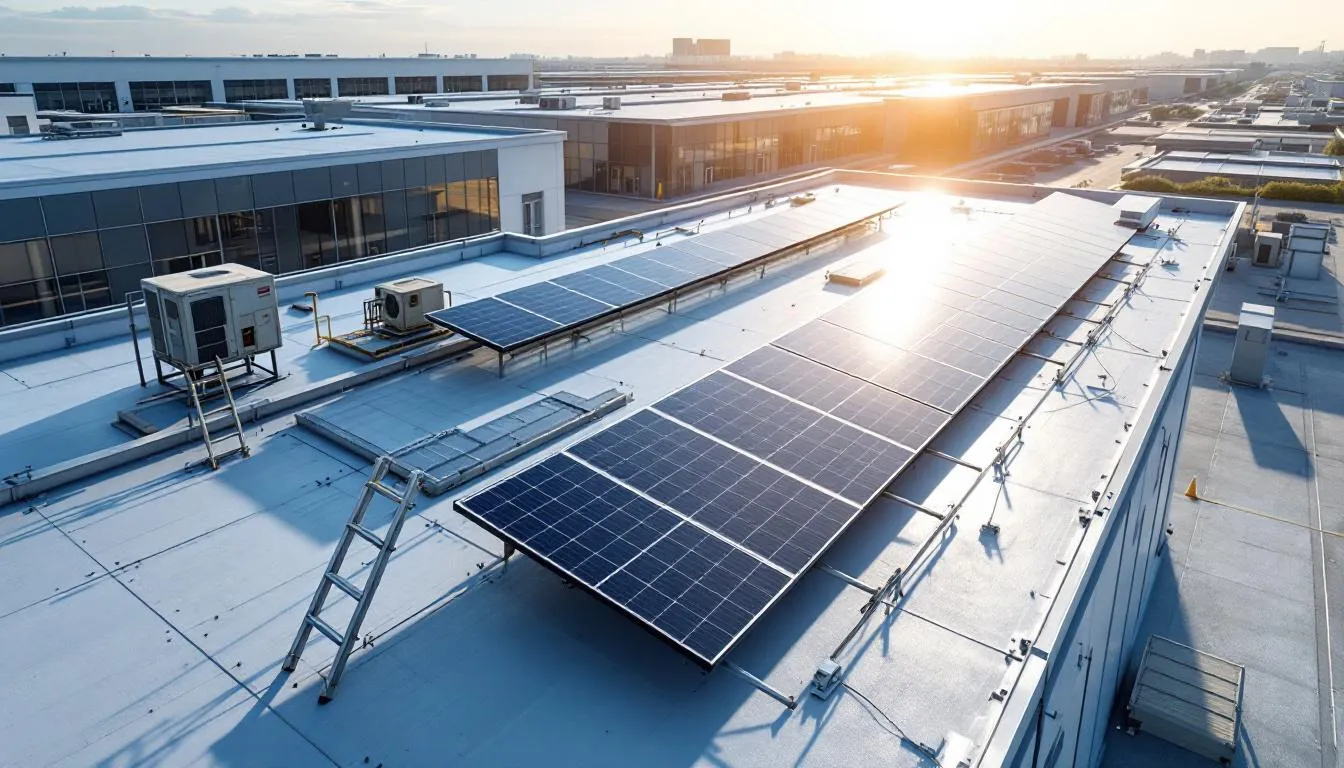
Industrial Flex Space Roofing work in San Diego starts with roof condition, access, drainage, existing assembly, occupant impact, and whether repair, restoration, maintenance, or replacement is the practical next step.
Request a quoteIndustrial flex is the most variable building type we roof. A single flex building might hold a light-manufacturing shop, a distribution tenant, a biotech company's overflow lab, a service contractor's yard, and a small office user, sometimes all at once across subdivided bays, and almost always shifting between uses as leases turn over. The roof has to perform across every one of those occupancies and survive the modifications each new tenant brings. We roof flex space in San Diego's deep industrial inventory: the multi-tenant parks along Miramar Road and Kearny Mesa, the Sorrento Valley and Mira Mesa flex buildings serving the tech and life-science overflow, the Otay Mesa and Kearny Villa logistics-adjacent product, and the older tilt-wall stock spread through Clairemont and the Central corridor.
Every tenant improvement on a flex roof leaves a mark. New rooftop HVAC for an upfit, fresh electrical and data penetrations, exhaust for a shop tenant, equipment set outside the original loading plan, it accumulates lease after lease, and most of it never makes it into the property's records. That's why a penetration inventory survey leads every flex roofing scope we write. We photograph and map every penetration on the roof, compare it against original construction documents where they exist, and flag the non-standard or improperly sealed openings that have to be remediated before new membrane goes down. Skip that step and you inherit someone else's undocumented leak the day your warranty starts.
A pure single-user warehouse has a predictable rooftop. A multi-tenant flex building does not, different bays carry wildly different equipment density, foot traffic from several tenants' separate HVAC service contractors, and loads that were never coordinated against each other. We design the membrane and attachment for the heaviest realistic condition the roof will see across its tenant mix, and where equipment density or service traffic is high we step up from a baseline assembly to one with greater puncture and traffic resistance. The roof has to be specified for the building's whole working life, not just its current rent roll.
San Diego's flex stock spans decades of construction. On one end you've got 1970s and 1980s tilt-wall buildings still carrying aging built-up roofs; on the other, modern pre-engineered metal buildings with standing-seam or R-panel roofs. The reroof approach follows the deck. For tilt-wall and concrete flex, 60-mil TPO mechanically attached over new polyiso is the standard, cost-effective path, and where rooftop equipment density or multi-tenant traffic runs high we'll move to 80-mil TPO or 60-mil PVC fully adhered. For pre-engineered metal buildings, a silicone-coated metal restoration or a retrofit standing-seam recover often extends service life without a full teardown, evaluated against full replacement based on panel condition, purlin spacing, and load capacity.
The most overlooked roofing risk on flex property happens between tenants. When a tenant vacates and pulls its rooftop HVAC, the open curbs are routinely left under temporary protection that fails within a rain event or two, and a vacant bay collects debris and clogs drains faster than an occupied one, so the problem compounds unseen. Any flex roof inspection during a lease transition should confirm curb-cap status, verify that the departed tenant's penetrations are properly sealed, and check that the drains are clear. We build those checks into lease-turnover inspections so an empty bay doesn't quietly soak the deck before the next tenant signs.
Multi-tenant work runs on a bay-by-bay occupancy map and a lease-contact list from property management. We identify which tenants have live rooftop equipment, which bays are vacant, and which tenants are sensitive to noise or HVAC downtime, then sequence the work and daily dry-in around that picture. Tenants get advance notice but communicate through the property manager, one channel, not a dozen crew-level conversations. It keeps the project clean for the owner and predictable for the tenants.
Flex roofs rarely get replaced all at once. A building changes hands, a single bay's roof gets patched after a tenant leak, a corner section gets recovered when an HVAC unit is swapped, and over a decade you end up with a patchwork of membranes, ages, and whoever-was-cheapest repairs, with no coherent warranty behind any of it. When we reroof flex property we sort that out: we either tie new work into a documented manufacturer warranty that covers the whole roof area, or we clearly define where the warranted system stops and what the owner is carrying on the older sections. Mixing membrane types and chasing prior patch repairs is exactly how warranty claims get denied later, so we map the existing roof's history before we add to it. For multi-tenant buildings, that single coordinated warranty is also what lets a property manager answer a tenant's leak complaint with a clear chain of responsibility instead of a finger-pointing exercise.
Flex roofing is priced per roof square on membrane specification, existing assembly condition, penetration density, and bay configuration, with fixed-price proposals after a roof walk and core sample where needed. For investors holding multiple flex properties across the San Diego market, we deliver standardized condition reports that drop straight into capital planning, so reroof timing across a portfolio becomes a budget decision instead of a surprise.
If you own or manage industrial flex anywhere from Miramar to Otay Mesa and you've got tenant-turnover leaks, undocumented penetrations, or a tired tilt-wall or metal roof, we'll survey it, core it where needed, and build a scope that holds up across whatever the building becomes next. Send the building location and we'll schedule the assessment.
Industrial Flex Space Roofing needs a roof scope that respects access, interior protection, rooftop equipment, drainage paths, and work-hour limits for that facility type.
Start a Request
A practical roof scope tells the owner what is urgent, what can wait, what needs testing, and which details change the budget.
San Diego roof work should account for marine air, reflective roof requirements, tenant operations, drainage, and rooftop service traffic.
Photos tied to roof areas, drains, penetrations, and sheet metal
Repair, coating, recover, replacement, and maintenance paths separated
Access, staging, tenant notices, work hours, and daily dry-in reviewed