

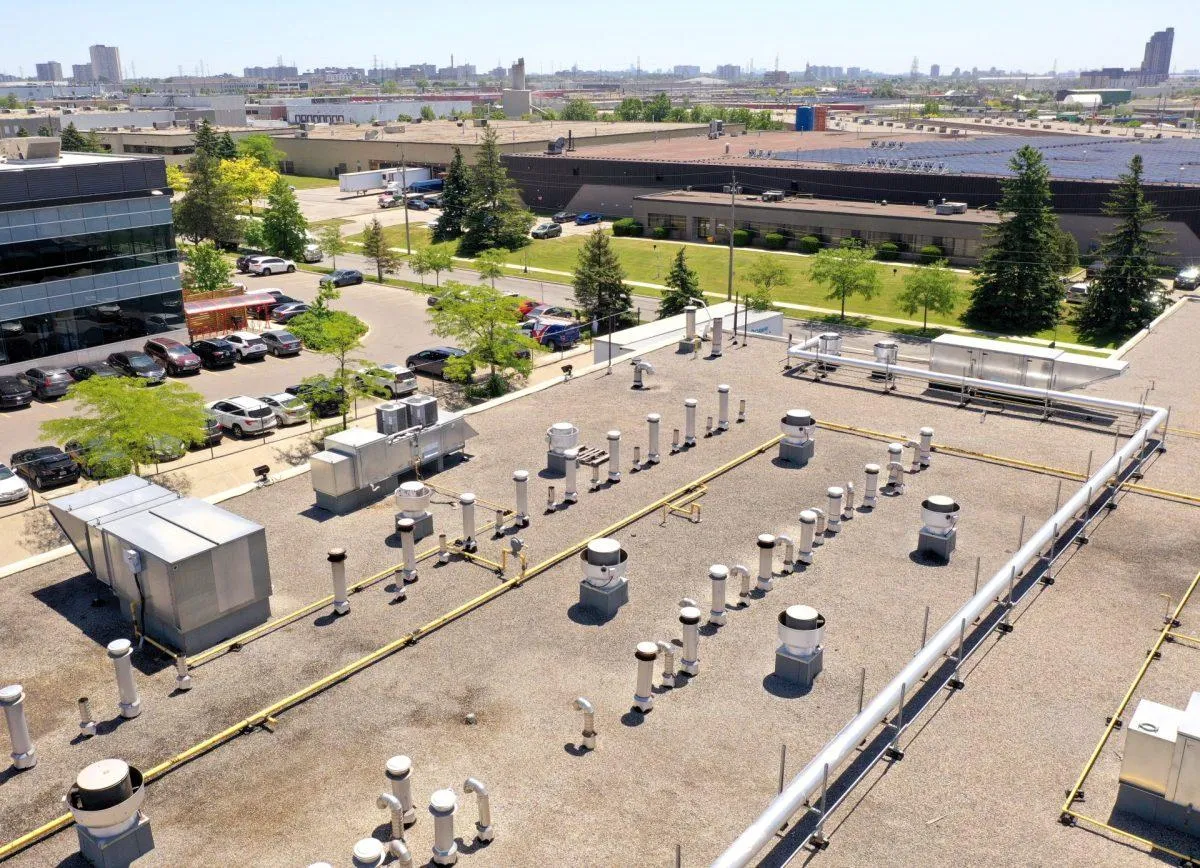
Food Processing Facility Roofing work in San Diego starts with roof condition, access, drainage, existing assembly, occupant impact, and whether repair, restoration, maintenance, or replacement is the practical next step.
Request a quoteFor most buildings a roof leak is a maintenance ticket. Above a running production line it's a food-safety event, a potential product hold, a deviation report, and a conversation with a USDA or FDA inspector. We build food processing roofs in San Diego to remove that risk at the source rather than chase it after the fact. San Diego's food manufacturing base is concentrated and diverse: the produce and fresh-pack operations tied to the Otay Mesa border crossing and the Imperial Valley supply chain, the seafood and tortilla and Mexican-food processors with deep roots in Barrio Logan and National City, the bakeries and beverage and craft-brewing plants spread across the Kearny Mesa and Miramar industrial corridors. Every one of them runs a wet, cold, heavily loaded roof.
Two forces define this building type from the roof down: washdown humidity rising off sanitation cycles, and the thermal and structural load of refrigeration sitting on top. Manage both correctly and the roof lasts. Miss either one and the deck corrodes or the insulation saturates with no visible leak to warn you.
Not every roofing material is acceptable above a food production environment, and that's the first thing we resolve. Membranes, but also adhesives, primers, and sealants, have to be confirmed against the facility's food-safety plan and the governing USDA or FDA framework before they go on the building. Many common roofing adhesives carry solvents that simply aren't allowed above food-contact zones. White TPO and PVC single-ply are generally suitable over enclosed processing areas, but the specific product and installation method get verified with the plant's QA team rather than assumed. We don't bring a material onto a food plant until it's cleared the plant's own review.
High-pressure, high-temperature sanitation is the heartbeat of a food plant, and it pushes a relentless column of warm moist air up against the underside of the roof. That vapor wants to migrate into the assembly and condense where it cools. Without a properly designed vapor retarder matched to the interior conditions, the insulation wets from below, the deck corrodes, and the first symptom shows up as a structural problem years before any water reaches a ceiling tile. We design the vapor control for the actual interior environment of each processing space, not from a generic detail, because in this building type the damage hides inside the roof.
Freezer rooms, blast cells, and chill spaces turn the roof above them into part of the cold chain. The assembly has to maintain thermal continuity or condensation forms inside it, driving deck corrosion and insulation failure. Tapered insulation over refrigerated areas gets designed around the actual operating temperatures and the vapor-drive direction for San Diego's mild, humid coastal climate, and we coordinate with the refrigeration team so roof work never compromises a coil, a condensing unit, or the temperature integrity of the space below. Standing water over a freezer is doubly damaging: it adds thermal load to the refrigeration system and accelerates corrosion at the same time, so drainage design is not optional here.
Food plant roofs carry weight, large make-up-air units, refrigeration racks, ammonia or CO2 system components, process exhaust, and the dense penetration field that comes with all of it. We inventory every curb and penetration, verify deck capacity before adding insulation thickness, and detail each penetration for both the load and the washdown-humidity environment it sits in. Process exhaust carrying steam, grease, or food particulate gets its own engineered flashing rather than a repeated stock detail.
San Diego food plants commonly run two or three shifts with a single weekly sanitation window as the only time the production floor is quiet. Any work that opens the envelope above an active line has to live inside that window, with the QA manager confirming the floor is clean and protected before we start and dried-in before production resumes. We phase the entire project around the production calendar, not the other way around, and we keep temporary dry-in staged so a section is never left open against a shift change.
Food plants don't only stress the roof from below. Cooking, frying, smoking, and rendering operations exhaust grease and food particulate onto the roof surface, where it builds a film that holds moisture, feeds biological growth, and degrades the membrane and edge metal over time. Bakeries and tortilla operations throw flour and oil; seafood processors push briny, corrosive exhaust. We place and detail exhaust fans to keep the discharge plume off the field where we can, specify grease-resistant membrane and walkway protection in the discharge zones, and build a realistic cleaning and maintenance plan into the closeout so the surface doesn't quietly cook itself. On older plants we frequently find the membrane already saturated with grease around the kitchen and process exhaust, that's a zone we evaluate honestly for replacement rather than coating over.
If a leak develops over an active line, the response isn't just patching, it's immediate contact with QA and facilities for product-hold evaluation and incident documentation, priority mobilization for temporary dry-in, and records that feed the plant's reporting. Roof condition is a standard line item in USDA and FDA inspections, so we leave behind the condition documentation and repair history a QA manager can hand an inspector to show proactive maintenance.
If you run a processing, packing, bakery, seafood, or beverage plant anywhere from Otay Mesa to Miramar and the roof is showing rust, condensation staining, or ponding over a cold room, we'll walk it on your terms and build a scope that protects what's underneath. Send the building location and we'll schedule the assessment.
Food Processing Facility Roofing needs a roof scope that respects access, interior protection, rooftop equipment, drainage paths, and work-hour limits for that facility type.
Start a Request
A practical roof scope tells the owner what is urgent, what can wait, what needs testing, and which details change the budget.
San Diego roof work should account for marine air, reflective roof requirements, tenant operations, drainage, and rooftop service traffic.
Photos tied to roof areas, drains, penetrations, and sheet metal
Repair, coating, recover, replacement, and maintenance paths separated
Access, staging, tenant notices, work hours, and daily dry-in reviewed